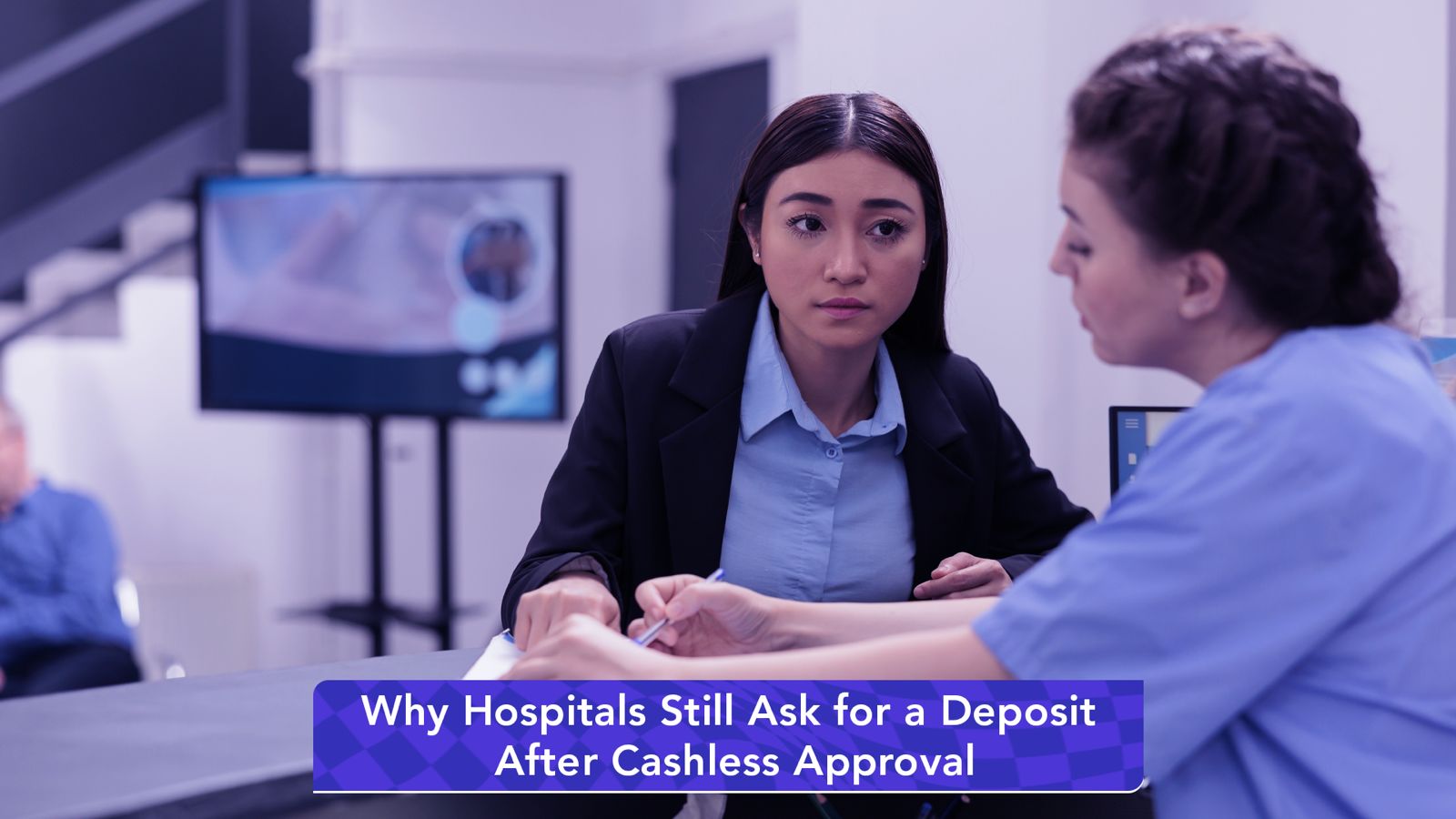
Cashless approval during hospitalisation brings relief to families, but many patients still get confused when hospitals ask for a refundable deposit.
The answer is simple. Cashless health insurance reduces major hospitalisation expenses, but it does not always mean every rupee on the final bill is automatically covered by the insurer.
Cashless approval usually covers only the admissible pre-authorised amount, while certain charges, exclusions, consumables, room upgrades, or pending claim verifications may still create a patient-pay amount.
In this blog, let’s understand why hospitals ask for deposits even after cashless approval and how the cashless claim process actually works.
What is Cashless Health Insurance?
Cashless hospitalization means your insurance company directly settles eligible medical expenses with the hospital instead of asking you to pay the full amount upfront.
However, cashless approval only applies to admissible expenses covered under your policy terms. Insurance companies do not automatically pay every charge included in the final hospital bill.
Your health insurance policy may include room rent limits, exclusions, waiting periods, co-payment clauses, consumable restrictions, and sub-limits for specific treatments. These policy conditions decide how much the insurer will finally approve during claim settlement.
That’s why two patients receiving similar treatment may still end up paying different amounts out of pocket.
Real-Life Example
Rahul and Arjun both undergo surgeries costing ₹2 lakh.
- Rahul has a comprehensive health insurance policy with no room rent restrictions.
- Arjun’s policy includes room limits and several exclusions.
Even though both receive cashless approval, Rahul may pay almost nothing, while Arjun may still need to pay ₹40,000–₹50,000 personally.
This is one of the biggest reasons hospitals collect deposits during admission.
What Insurers Check Before Final Claim Approval
One of the biggest misconceptions about health insurance is that approval means the insurer has agreed to pay the complete bill. In reality, the first approval given by the insurer is usually only a provisional approval.
When a patient gets admitted, the hospital sends initial medical details to the insurer or TPA (Third Party Administrator). Based on the doctor’s diagnosis and estimated expenses, the insurer approves a tentative amount for treatment.
But at that stage, the insurance company has not yet seen:
- The final bill
- Additional treatments
- Extra medicines
- ICU extensions
- Complications during surgery
- Extended hospital stay
In simple words, the insurer is approving treatment based on estimated costs, not the final reality.
Medical conditions can change quickly, which can increase the final bill. That’s why hospitals collect deposits as a temporary safeguard until the final claim is verified and settled.
Insight: Insurance approval works in layers — estimate first, confirmation later.
Understanding Excluded Items in Health Insurance
This is the part that shocks most first-time policyholders.
People assume health insurance covers every hospital expense. But during discharge, they often see charges marked as “non-payable” or “not covered,” which creates confusion and frustration.
In reality, insurance companies only pay for medically necessary and policy-covered expenses. Many small but important charges are excluded.
These usually include: Gloves, PPE kits, Sanitization charges, Registration fees, Administrative costs, Attendant expenses, and Personal comfort items
Individually, these may look small, but together they can add up to a significant amount in the final bill.
For example, even if insurance covers most of a ₹2 lakh bill, a patient may still need to pay ₹15,000–₹25,000 for excluded items.
Because hospitals know some expenses may not be covered by insurance, they often collect a deposit in advance to avoid payment issues during discharge.
How Room Upgrades Lead to Higher Medical Bills
Here’s something many people discover only after receiving a shocking final bill.
Your hospital room category directly affects your insurance payout. Many health insurance policies have room rent limits.
For example, your policy may allow a room worth ₹5,000 per day, but the hospital may offer a ₹9,000 per day deluxe room.
If you choose a higher room category, it can lead to proportionate deduction, where the insurer reduces payment not only for room charges but also for related costs like surgery fees, nursing, and doctor consultations.
This is why even with high coverage like “₹10 lakh health insurance coverage,” patients may still end up paying a significant amount. Hospitals are aware of this rule, so they may ask for a higher deposit when a room upgrade is selected to manage possible insurance deductions later.
Rule of Thumb: Comfort upgrade may lead to a claim reduction multiplier.
Hospitals Also Face Delays From Insurance Companies
Another important thing people rarely consider is that hospitals themselves do not receive instant payment from insurers.
Before releasing final settlement, insurers conduct detailed audits where they verify documents, treatment necessity, medical reports, prescriptions, and billing accuracy.
If anything is incomplete or unclear, the insurer may delay approval, request additional documents, reject certain expenses, or temporarily put the claim on hold.
Until the process is completed, hospitals often keep deposits as a buffer against delayed or reduced insurance payments. This is why discharge delays are common in cashless hospitalization cases, and families may mistakenly assume the hospital is delaying discharge, while in reality, the hospital is waiting for final insurer clearance.
Is Cashless Health Insurance Still Worth It?
Absolutely.
Even with deposits and non-payable expenses, cashless health insurance still protects families from major financial stress during emergencies.
A hospitalization bill of ₹5 lakh without insurance can be very difficult for most families to manage immediately. Cashless insurance reduces this burden by directly covering large approved medical expenses with the hospital.
The real issue is not cashless insurance itself, but lack of awareness. Many people buy insurance without fully understanding room rent limits, exclusions, waiting periods, consumables, co-payment clauses, and claim conditions. When expectations don’t match reality, confusion and frustration naturally happen.
Not sure how much health insurance you need?
Your age, city, family size, existing cover, and medical costs can all affect the right coverage amount. The free Inka Insurance Report helps you understand your health, term, and critical illness needs before you compare policies.
Final Thoughts
Hospitals may ask for a deposit even after cashless approval because the approval is usually provisional and based on an estimated amount.
This deposit may cover:
- Non-payable items or consumables
- Room upgrades or package limits
- Policy exclusions or sub-limits
- Pending documents or final approval
- Any patient-pay amount not cleared by the insurer
Once the final settlement is completed, hospitals are generally expected to refund the deposit after adjusting only non-covered expenses.
So, the next time someone asks, “My insurance is cashless, so why am I still paying?” you’ll know the answer before reaching the hospital billing counter.