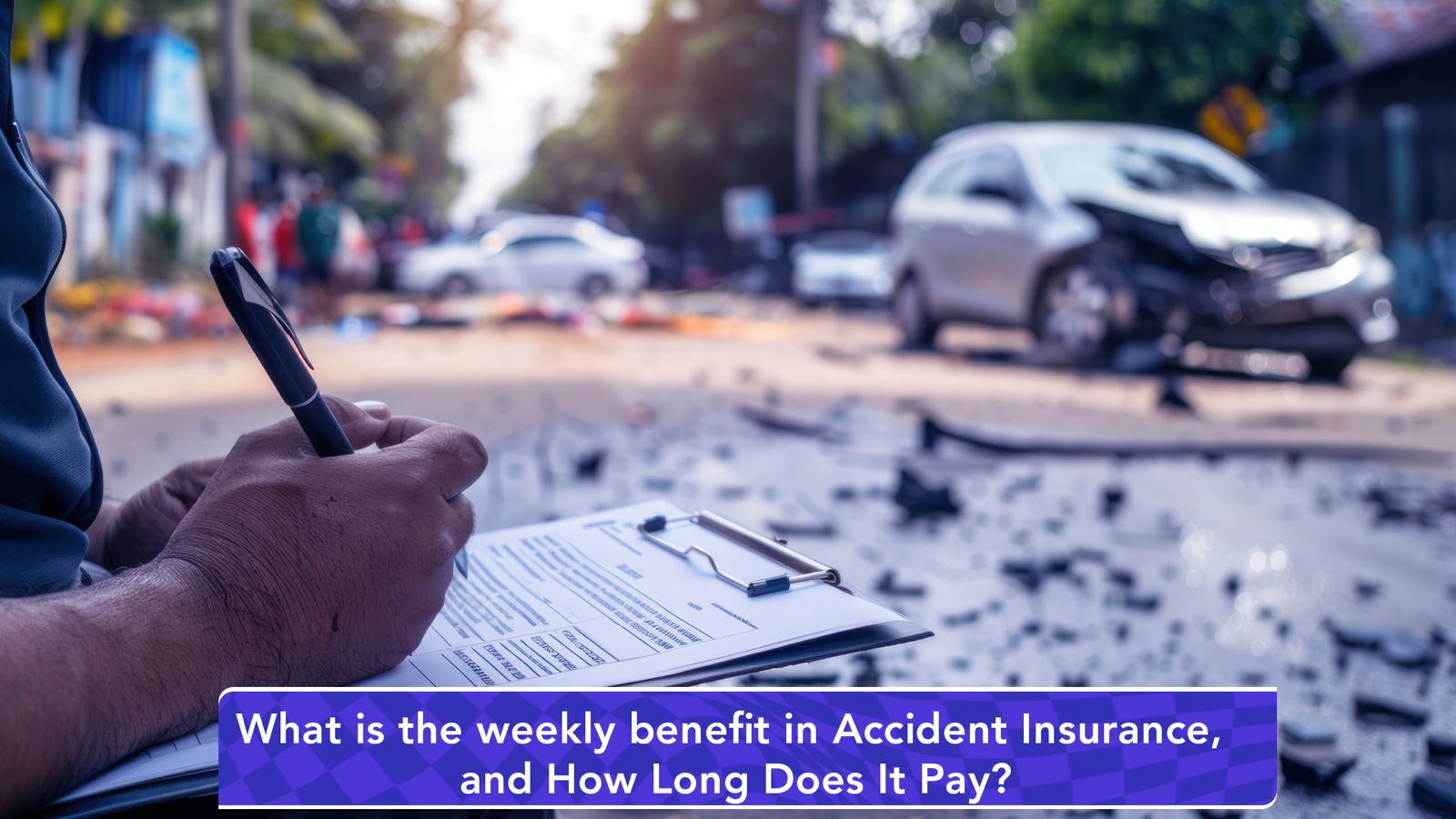
Accidents can happen without warning. A road accident, fall, fracture, or workplace injury may leave a person unable to work for weeks or months. During this recovery period, regular income can be affected.
This is where the weekly benefit in accident insurance can help.
Weekly benefit is a periodic payout offered under some personal accident insurance policies when an accident causes temporary total disablement. If an accidental injury makes you completely unable to work for a temporary period, the policy may pay a fixed weekly amount.
However, this benefit is not automatic in every accident claim. The amount, waiting period, payment timing, and maximum duration depend on the policy wording and schedule.
What is the Weekly Benefit in Accident Insurance?
Weekly benefit in accident insurance is temporary financial support paid when an insured person cannot work because of an accidental injury.
It is usually linked to temporary total disablement, often called TTD in insurance documents. This means the insured person is fully unable to perform their regular work for a temporary period due to the accident.
In simple terms, the weekly benefit may apply when:
- The injury is caused by an accident
- The insured person is temporarily unable to work
- The disablement is total, not partial
- The claim meets the policy terms and conditions
For example, if someone fractures a leg in an accident and cannot attend work for several weeks, the policy may pay a weekly benefit during the eligible disablement period, subject to the policy terms.
The purpose of this benefit is to provide some income support while the insured person recovers. It does not mean every injury will qualify. The accident, disablement period, medical proof, and policy conditions all matter.
Is Weekly Benefit a Full Salary Replacement?
No. Weekly benefit is usually not a full salary replacement.
Many people assume accident insurance will pay their full salary if they cannot work after an accident. In most cases, that is not how this benefit works.
Weekly benefit is usually paid as:
- A fixed weekly amount mentioned in the policy schedule
- A capped percentage of the sum insured
- A benefit amount subject to policy limits
For example, if your policy offers a weekly benefit of ₹5,000 per week, that is the eligible amount you may receive, even if your normal weekly income is higher.
So, weekly benefit should be understood as limited temporary financial support, not a guaranteed full income replacement.
When Is Weekly Benefit Payable?
Weekly benefit is generally payable only when the claim meets the policy conditions.
Usually, the insurer will check whether:
- The injury was caused by an accident
- The accident resulted in temporary total disablement
- The insured person was unable to perform regular work
- The disablement continued beyond the waiting period
- The claim does not fall under policy exclusions
Insurers may ask for medical reports, doctor certificates, accident details, treatment records, employer confirmation, or income-related documents before approving the claim.
Since every policy is different, it is important to read the policy wording carefully before assuming that the weekly benefit will apply.
What Is the Waiting Period for the Weekly Benefit?
Some accident insurance policies include a waiting period, also called an elimination period. This is the time you must wait before the weekly benefit becomes payable after an accident.
For example, if your policy has a 7-day waiting period and you’re unable to work for only 5 days, you may not receive the weekly benefit.
The waiting period determines:
- When the weekly benefit starts
- Whether a short period of disablement qualifies for payment
- If your claim meets the policy conditions
If your disablement continues beyond the waiting period, the weekly benefit may become payable according to your policy terms. Checking the waiting period before purchasing personal accident insurance can help you understand when financial support may be available.
How Long Does Weekly Benefit Pay?
Weekly benefit does not continue forever. Accident insurance policies usually set a maximum payment period.
In many policy wordings, the weekly benefit may be capped at up to 104 weeks. However, the exact limit is policy-specific. Some policies may offer a shorter period, such as 50 weeks or 52 weeks. Others may have different limits based on the plan, sum insured, occupation, or benefit structure.
The payment may continue only while the insured person remains temporarily and totally disabled, subject to the maximum limit mentioned in the policy.
Once the insured person recovers and is medically fit to return to work, the weekly benefit usually stops, even if the maximum benefit period has not been reached.
Simple Example of Weekly Benefit
Let us say a person has a personal accident insurance policy with a weekly benefit of ₹10,000, a waiting period of 7 days, and a maximum benefit period of 104 weeks.
The person meets with an accident and cannot work for 6 weeks. If the claim is approved and the disablement qualifies under the policy, the insurer may pay the weekly benefit after applying the waiting period and other conditions.
However, if the person is unable to work for only 4 or 5 days, the benefit may not be payable if the waiting period is 7 days.
This example shows why both eligibility and timing are important in a weekly benefit claim.
Does Weekly Benefit Pay During Recovery or After Recovery?
This depends on the policy wording.
Some policies may pay the weekly benefit periodically while the insured person remains temporarily disabled. Other policies may pay only after the temporary disablement period ends and all required documents are submitted.
This means two policies may offer the same weekly benefit amount but follow different payment processes.
Before buying accident insurance, check whether the benefit is paid during the disablement period, after medical confirmation, after the temporary disablement period ends, or only after claim documents are reviewed and approved.
What Is Temporary Total Disablement?
Temporary total disablement means the insured person is completely unable to perform normal work for a temporary period because of an accidental injury.
It is different from permanent disability. For example, if a delivery professional fractures a leg and cannot work for 8 weeks, this may be considered temporary total disablement if the policy conditions are met.
Weekly benefit usually applies to temporary total disablement, not every injury or disability.
What Should You Check Before Buying Accident Insurance?
Before choosing a personal accident insurance policy, check these important details:
- Whether the weekly benefit is included in the policy
- The weekly benefit amount and whether it is fixed or linked to the sum insured
- The waiting period, maximum payment duration, exclusions, and claim payment process
- Whether your occupation affects eligibility, premium, or benefit limits
These details can make a major difference when you file a claim. A policy may look useful at first, but the waiting period, maximum benefit period, and exclusions decide how helpful it will be during an actual accident-related income loss.
Final Thoughts
The weekly benefit in accident insurance is a periodic payout provided when an accident causes temporary total disablement and leaves the insured person unable to work for a while.
It is usually paid as a fixed weekly amount or a capped percentage of the sum insured. It is not normally a full salary replacement. Payment generally starts only after any waiting period mentioned in the policy schedule.
Many policy wordings cap weekly benefits at up to 104 weeks, but the exact limit depends on the specific policy. Some policies may pay during the disablement period, while others may pay only after the temporary disablement period ends.
Before buying accident insurance, read the policy wording carefully, check the waiting period, understand the maximum benefit period, and confirm how claims are paid.